Last week, Naviant joined GovTech for a live conversation on AI in government — what’s delivering real value, and how agencies can get started. The panel brought together practitioners from two Naviant customer agencies alongside Naviant’s VP of Public Sector, Vince Hanson, for an honest, unscripted discussion about where AI stands today in the public sector.
If you missed it, here are the key takeaways you need to know.
Who Was in the Room
The conversation featured three voices with direct, on-the-ground experience:
- Vince Hanson — VP of Public Sector, Naviant. Over 25 years and 600+ technology deployments across government agencies of all sizes.
- Tim O’Toole — Director of Records and Information Management, Central Florida Expressway Authority. Twenty-five-plus years in records management, approaching AI from a governance and compliance lens.
- Shawnene Sharratt — Senior Business Analyst, Transportation Investment Corporation (a Crown Corporation of the Province of British Columbia, Canada). Leading a large-scale OnBase implementation while drawing on prior experience deploying AI in field operations.
- Sean McSpaden — the moderator, serves as a Senior Fellow with the Center for Digital Government and the Center for Public Sector AI.
The Pressure Is Real (and It’s Not Going Away)
The conversation opened with something every government professional already knows: agencies are being asked to do more with fewer people, tighter budgets, and rising constituent expectations.
Vince put it plainly: retirements are leaving institutional knowledge gaps that are expensive and slow to fill. New employees spend months ramping up, and in many cases, turnover starts within six months because the workload is unmanageable. Meanwhile, constituents increasingly expect real-time, self-service access to information.
“The doing more with less really resonates with a lot of the customers I’m working with. These AI toolsets are needed for speed and consistency.”
Tim added that for agencies managing public records compliance, like Florida’s 15+ public records exemptions, the volume and complexity of that work isn’t decreasing.
Shawnene’s framing was around timeliness: for Transportation Investment Corporation building capital infrastructure at scale, the ability to get the right information to the right people at the right time is mission-critical.
The pressure is consistent across government levels and geographies. What’s changing is that agencies now have tools that can actually help.
Where to Start: Practical First Steps That Actually Work
One of the most useful parts of the session was a frank discussion about how agencies can begin making progress without getting stuck in “analysis paralysis.”
Shawnene described a deliberate approach at Transportation Investment Corporation: start with low-stakes, high-familiarity wins such as meeting minutes or document drafting for staff who work in English as a second language. These aren’t glamorous use cases, but they build trust in the technology and give employees a positive first experience which matters enormously when you’re trying to shift a culture.
Tim echoed the same theme, noting how AI has sparked cross-departmental conversations that simply weren’t happening before. When colleagues start asking each other, “how are you using that tool?,” that’s cultural momentum.
Vince added a critical planning principle: the agencies that succeed invest in communication before technology. This means getting stakeholders together, creating honest feedback loops, and documenting what’s working and what isn’t so each phase of deployment informs the next.
“Start with the process, not the technology.”
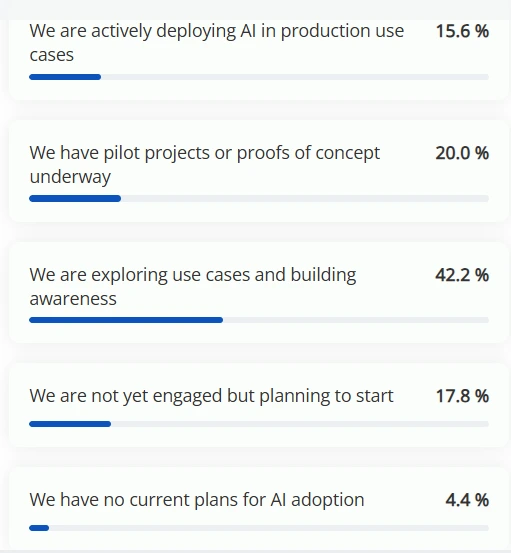
The poll results from the session reflected where most agencies are right now: nearly a majority reported they’re still exploring use cases and building awareness. That’s exactly the audience for whom these early-mover insights are most valuable.
Breaking Down Data Silos Without Blowing Up What’s Working
A recurring theme was the challenge of siloed data with documents, case files, and records scattered across systems that don’t talk to each other. The conventional wisdom has been that you need to consolidate everything into a single repository. Shawnene pushed back on that.
“We’re allowed to have silos because AI reaches into those silos.”
At Transportation Investment Corporation, different user groups like engineers, project controls teams, HR, finance use specialized tools that are purpose-built for their work. Those tools aren’t going anywhere. What changed is AI can now reach across those systems, retrieve the right information, and wrap it in the appropriate context for whoever needs it. Specialists keep their specialized tools. Everyone gets better access to information.
Tim described a parallel effort at Central Florida Expressway Authority: building an AI agent that can crawl repositories, identify duplicates, classify records versus non-records, and apply retention labels — work that previously required painstaking manual review.
A Real-World Example: Court Docketing with AI
Vince shared one of the most concrete examples of the session: a county court system that faced a significant knowledge transfer problem. Experienced court clerks were retiring, and new hires had to learn a court case management system with 1,400 possible docket codes. The ramp-up time was long, mistakes were common, and turnover was high.
Naviant helped the agency implement a local language model to handle intake and automate docket code entry. During the pilot, the model achieved roughly 90% accuracy on the court’s most-used codes.
Here’s where the story gets interesting: the agency decided not to have the AI replace their staff on the front end. Instead, they configured it to serve as a quality assurance layer flagging errors, creating learning opportunities, and supporting human review rather than bypassing it. No jobs were eliminated. Staff got better and faster at their work.
Watch the Full Webinar Recording“No one’s losing their jobs — but using AI to do their job better. A perfect example of how you can use technology alongside humans’ side by side.”
Constituent Self-Service: The Cost of Not Acting
Vince walked through a cost framework that reframes the urgency of AI investment in constituent-facing services. The rough economics:
- A constituent who can self-serve on a well-designed website costs approximately $1 to service.
- A constituent who needs to call the agency costs approximately $5.
- A constituent who gives up on the phone and drives to the office costs $10 or more.
AI-powered natural language search — the kind that lets someone ask a question in plain English (or Spanish, or any language) and get a direct answer with the source documents cited — can dramatically expand the self-service tier. Vince demonstrated a live example using county meeting and agenda records, showing how an AI agent can surface specific answers and show the supporting documentation, rather than forcing users to search, click, and read through documents themselves.
The implication: every dollar not invested in better self-service tools is a dollar spent on more expensive service channels.
Data Security and Privacy: What Agencies Are Actually Doing
Audience questions surfaced the topic that most government professionals are grappling with: how do you use AI without compromising the privacy and security of public data?
Shawnene was candid. In a sector like engineering and construction, where documents contain sensitive project data, the challenge of finding AI tools that don’t require feeding proprietary data into public data lakes is real and unsolved. Her advice: find partners who understand government’s unique constraints and have experience solving for them.
Tim described a layered approach at Central Florida Expressway Authority: using OnBase (Hyland Software’s enterprise content management platform) to create visibility controls that separate publicly accessible documents (roadway plans) from confidential or exempt records. On top of that, they’re applying sensitivity and retention labels to help AI tools learn what’s protected. And critically: no matter how much gets automated, a human reviewer stays in the loop.
The consistent message from both practitioners: automation is not a substitute for accountability. Human review remains essential, at least until confidence and trust in specific use cases is firmly established.
The Highest-Value Use Cases for Getting Started
When asked where resource-constrained agencies should focus first, Vince offered a clear list of high-ROI, high-volume, repeatable processes:
- Constituent request and intake processing
- Invoice processing and AP automation
- Automated redaction of PII from public records
- Application and renewal processing
The throughline: look for large-volume, transactional, rule-based processes where errors are costly and manual effort is significant. Those are the areas where AI delivers measurable time savings fastest.
What’s Coming: Looking Ahead 2–3 Years
The closing segment asked each speaker to look forward. A few threads stood out:
Shawnene’s near-term focus is on AI-assisted review of engineering drawings — helping reviewers understand exactly which elements changed between revisions so they can focus their attention where it’s actually needed rather than reviewing everything from scratch.
Tim emphasized the cultural work is as important as the technical work. Breaking down the “that’s how we’ve always done it” mentality requires showing people AI is going to help them, not replace them. He noted that the reception has been more positive than he expected.
Vince closed with a longer lens: as government workforces continue to shift — retirements, DOGE-driven headcount reductions, new hires who are digital natives — agencies that have invested in AI fluency and infrastructure will be positioned to absorb that change. Those that haven’t will struggle to keep pace.
“Think like a beginner. Don’t solve this the way you used to. Think about what the new toolset makes possible.”
Ready to Explore What AI Could Do for Your Agency?
Naviant works with government agencies at every stage of the AI journey — from initial use case discovery to full-scale deployment. Whether you’re exploring where to start or ready to move from pilot to production, we’d welcome the conversation.
Talk to Our Public Sector TeamWatch the Full Webinar Recording